ORE exam for Indian dentists: documents, booking, capacity
Reviewed by Dr. Utkarsh Rathore, BDS · UP State Dental Council Reg. 21803 · 23 Nov 2026

Most dentists whose primary qualification was gained outside the UK or EEA must pass the Overseas Registration Examination (ORE) before they can apply for UK registration [1]. An Indian BDS falls outside the UK and EEA. Places are very hard to get, so the process can take years rather than months [1].
What the ORE is
The ORE has two parts. Part 1 tests how you apply knowledge to clinical practice. Part 2 is where you show practical clinical skills [1].
The GDC points candidates to its exam provider's website for the specification, guidance and policies for each part [1]. Read those before you plan your preparation.
The rules on attempts and time
Three limits matter most:
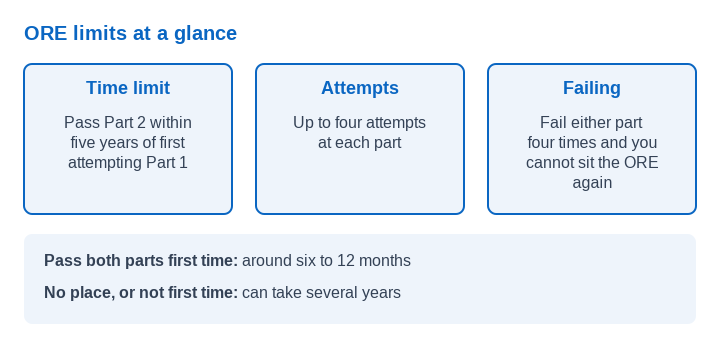
- You must pass Part 2 within five years of first attempting Part 1 [1].
- You have up to four attempts at each part [1].
- If you fail either part four times, you will not be allowed to sit the ORE again [1].
If you pass both parts on the first attempt, the GDC says you could finish in around six to 12 months [1]. It also says that if you cannot get a place straight away, or do not pass first time, it can take several years [1].
Documents you need for the application
You apply online by setting up an account. You are added to the ORE candidate list once the process is complete [1]. The application guidance lists several documents [2].
Character reference. You download a form, ask your referee to complete it, then scan and upload it [2].
- If you apply within 12 months of graduation, it must come from the head of your dental school or their nominee [2].
- After 12 months, it can come from another professional, such as a doctor, dentist or lawyer, who has known you for over 12 months [2].
- A family member cannot be your referee [2].
- A handwritten or scanned signature is accepted. A typed signature is not [2].
Clinical references. You must show at least 1,600 hours of clinical experience treating patients in the dental chair. You may need more than one form to reach that total [2]. The forms must be no more than three months old when you apply [2].
Who signs depends on where the experience came from:
- For your primary dental degree, the dean of the dental school, or a professor or tutor acting for the dean, must be the referee. The dean's office must stamp the form [2].
- For post-qualification work, the verifier must be or have been registered with the regulator in the country where you worked, and must be or have been your employer [2].
- For UK temporary registration, the supervising consultant or consultants complete the form [2].
Identity and certified documents. You complete an online identity check, which works best on a mobile phone. You need a valid passport [2]. Whoever certifies your documents must be a different person from your character referee, and must be one of the professionals the GDC lists [2]. The source text available for this article cuts off before that list, so check the GDC page for who qualifies.
What happens when referees are slow
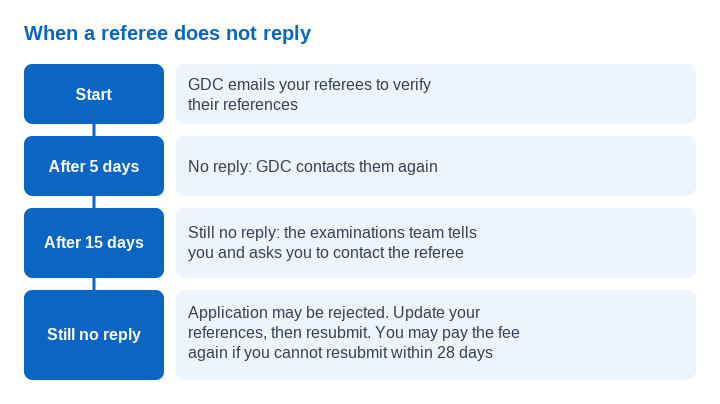
The GDC emails your referees to verify their references. It contacts them again if they have not replied within five days [2]. If there is still no reply after 15 days, the examinations team tells you about the delay and asks you to contact the referee yourself [2].
If the referee still does not respond, your application may be rejected. You would then need to update your references before resubmitting. You may also have to pay the application processing fee again if you cannot resubmit within 28 days [2].
In practice, tell your referees to expect the GDC's emails. Pick people who will reply quickly.
Costs
The GDC pages used for this article mention an application processing fee [2]. They do not give fee amounts for the application or for either exam part. Check the current figures on the GDC's own fee pages before you budget. Do not rely on third-party figures that may be out of date.
Booking and capacity
Once your application is complete, you join the candidate list for Part 1. You then log into your online account to check the next available sitting and book [1].
The GDC describes demand as extremely high. It says all places were taken within 30 minutes of a booking window opening this year [1]. Processing an application takes around 60 working days, and the GDC warns you may struggle to get a place over the next 12 months or more [1].
Some points that help you plan:
- The GDC emails advance notice of each booking window, and booking dates are on its website [1].
- You can book any sitting that suits you. You do not have to take the next one [1].
- Priority places go to candidates nearing the five-year limit, so they can complete Part 2, and to dental professionals with refugee status. Priority candidates are told in advance when the window opens [1].
Because windows fill so fast, have your account and details ready before the window opens. This follows from the GDC's account of how quickly places go [1].
Think about work before you apply
The GDC advises dentists planning to come to the UK to first consider employment opportunities. It also advises them to look at the extra requirements for working in the NHS [1]. It tells you to check whether you can work in the UK and to read the entry and stay details online [1].
If you only want to come for a limited time for training, teaching or research, the GDC has separate information on temporary registration [1]. That route is different from sitting the ORE.
A practical next step
Open the GDC's "how to apply" page for the ORE and list every document it asks for. Then ask your college and any employers whether they can provide the dean-stamped and employer-verified clinical forms, and how long that would take. DentalSync lists dental jobs and exam dates, which you can use alongside the GDC's own booking dates.
Frequently asked questions
Do Indian BDS graduates have to take the ORE?
Most applicants whose primary dental qualification was not gained in the UK or EEA need to pass the ORE before applying for registration [1]. Dentists whose qualifications are not recognised for UK registration can apply to sit it [2].
How many times can I attempt the ORE?
You can have up to four attempts at each part. You must pass Part 2 within five years of first attempting Part 1. If you fail either part four times, you cannot sit the ORE again [1].
What clinical experience evidence is needed?
You must provide one or more clinical references showing at least 1,600 hours of treating patients in the dental chair. The forms must be no more than three months old at the time of application [2]. Your dental school's dean, or someone acting for the dean, must be the referee for degree-based evidence, and the dean's office must stamp the form [2].
How hard is it to get an ORE place?
The GDC says demand is extremely high and that all places were taken within 30 minutes of a booking window opening this year. It also says you may have difficulty securing a place over the next 12 months or more [1].
Can I book any sitting?
Yes. You can book onto any sitting that suits you and do not need to take the next one. The GDC emails advance notice of each booking window [1].
Sources
- About the ORE. www.gdc-uk.org. https://www.gdc-uk.org/registration/overseas-registration-exam/about-the-ore
- Applying for the Overseas Registration Examination (ORE). www.gdc-uk.org. https://www.gdc-uk.org/registration/overseas-registration-exam/how-to-apply--overseas-registration-examination-(ore)
This guide was drafted with AI assistance from the sources listed above and reviewed by Dr. Utkarsh Rathore on 23 Nov 2026. Fees, dates and rules change: check the official source before you apply or pay.