Associate dentist salary or percentage: how to compare offers
Reviewed by Dr. Vaishali Kesarwani, BDS, MBA (Healthcare Management) · UP State Dental Council Reg. 21804 · 23 Nov 2026

A fixed salary pays you a set amount. A percentage offer pays a share of what your work produces or what the practice actually collects, and a hybrid pays a base plus a share [1][2]. To compare them, find out what the percentage is applied to and what is deducted first.
A note on sources: the material below comes from dental associations in the United States. It shows how pay formulas work and which questions to ask. It does not give Indian pay rates, and this article does not either. Use the questions on any offer you receive.
The main pay models
The American Dental Association (ADA) lists four common models [1]:
- Straight salary: a fixed gross amount, which a contract may state per year, month or day [1].
- Salary-plus: a base salary plus a commission based on some measure of your productivity [1].
- Straight commission: pay based only on the fees or revenue from your work [1].
- Net profit: pay based on total billings less expenses named in the contract [1].
A Georgia Dental Association article, written by a legal firm head and marked as partner-sponsored content, groups offers in a similar way. Its four groups are guaranteed salary only, guarantee plus production, production only, and daily or hourly pay [2].
The ADA also notes that straight salary is common in public health, academia and government agencies [3]. Percentage-based pay is more common in private practice and in dental service organisations [3]. That is the US picture. Check how your own offer is written.
Learn four terms before you compare
Percentage offers use words that sound alike but mean different things [1][3]:
- Total production: the amount the practice bills, based on its own fee schedule [1][3].
- Billable (adjusted) production: the amount the practice is allowed to collect. In the US sources, this is often set by a third-party payer [1][3].
- Collections: the net amount the practice actually receives [1].
- Collection percentage: collections divided by production, times 100 [1].
The ADA says you need to know whether the collection percentage is based on production or on adjusted production [1].
Why the base of the percentage matters
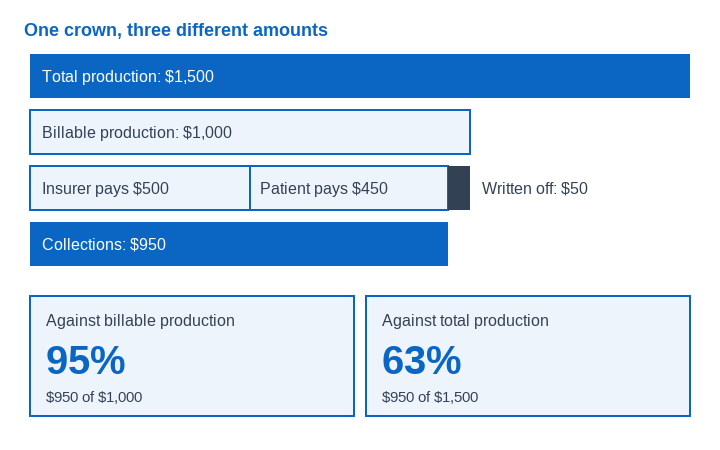
The ADA gives a crown example. The practice's fee is $1,500, which is the total production. The patient's insurance plan allows $1,000, and the practice cannot collect the difference from the patient. So billable production is $1,000 [3].
The insurer pays $500 and the patient pays $450. The practice writes off the last $50. Collections are $950 [3].
That gives a 95% collection percentage if you measure against billable production. Against total production it is 63% [3]. The ADA's point is that the same treatment gives very different figures depending on the base. Pay set as a percentage of any of them will vary accordingly [3].
So "30% of collections" and "30% of production" are not the same offer. Ask which one is written in the contract.
Questions for a collections-based offer
The ADA suggests asking what the collection percentage is [3]. If it is above 98%, the practice has strong collection policies. Paying on production or on collections then makes little difference [3].
Ask also whether the rate is worked out on total or billable production [3].
The Georgia article adds more questions for production-only pay [2]:
- What is the practice's historical collection rate?
- How often are production and collections reconciled?
- Is the formula clearly defined in writing?
It also warns that production-only pay can offer significant upside but has no income floor [2].
The ADA adds a question about patient mix. If some patients pay lower agreed rates, will the associate see most of them while the owner sees mostly full-fee patients [3]? The sources raise this for insurance plans. In any practice, ask who sees which patients and how that affects what you are paid on.
Reading a hybrid offer
A hybrid has a base and a variable part. The ADA's example is a monthly salary of $7,000 plus 10% of a monthly commission base of about $30,000. That is about $3,000 in commission and a possible monthly total of $10,000 [1].
This is a US example to show the arithmetic. It is not a benchmark.
With a hybrid, check these points:
- Targets. The Georgia article says to review production targets carefully. Are they realistic given patient flow, hygiene support, marketing and schedule availability [2]?
- Duration. A guaranteed salary is often used for an onboarding period of a few months to a year. Confirm how long it lasts and whether pay then moves to a production-based model [2].
- What the variable part uses. Production may be calculated on collections, adjusted production or a percentage of net receipts [2].
Deductions and extras
Some contracts use a net-profit model. In the ADA's example, $10,000 of production less $1,000 of lab fees and a discount leaves $9,000 as pay [1]. Expenses may be direct, such as lab fees and discounts, or indirect, such as overhead [1]. If your offer deducts anything before the percentage is applied, ask for the list.
Also look beyond chair time [2]:
- Bonuses. Check how they are calculated and when they are paid.
- Administrative duties. If you supervise staff or help add services, ask whether that is reflected in pay. On production-based pay, ask whether admin time reduces your earnings.
- Daily or hourly pay. Confirm whether a minimum number of hours is guaranteed and whether production expectations are tied to continued employment.
A simple way to compare
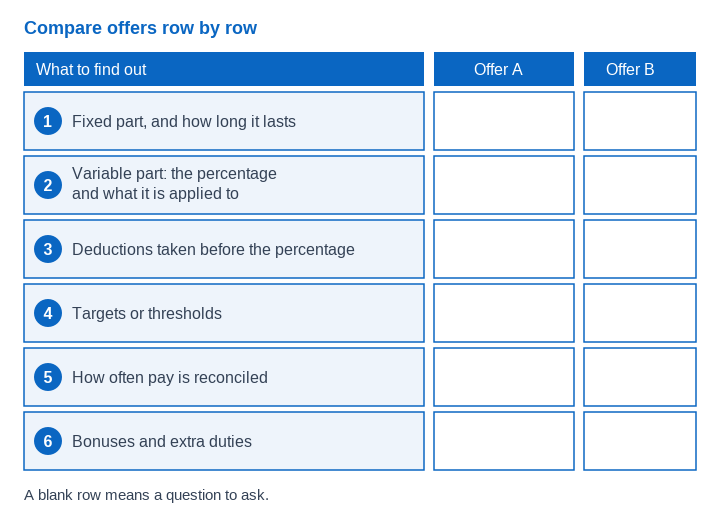
Put each offer in a small table with these rows:
- Fixed part, and how long it lasts.
- Variable part: the percentage and what it is applied to.
- Deductions taken before the percentage.
- Targets or thresholds.
- How often pay is reconciled.
- Bonuses and extra duties.
A blank row means a question to ask. The Georgia article warns that free online salary data can be outdated, overly broad, or not specific to dental practice structures [2]. Use the offer's own terms rather than a general figure.
Your next step
Before you reply to an offer, ask for the pay formula in writing. Then work out one sample month from it, using the practice's own collection figures, and see what you would be paid under each offer. If you are also looking at jobs or exam dates, DentalSync lists dental jobs and exam dates.
Frequently asked questions
What is the difference between production and collections?
Production is what the practice bills under its fee schedule. Collections are the net amount it actually receives [1][3]. In the ADA's crown example, production was $1,500 but collections were $950 [3].
Is a hybrid offer the same as a fixed salary?
No. A hybrid pays a base salary plus a commission tied to productivity [1]. The Georgia article says to check the production targets and whether they are realistic for the practice's patient flow [2].
What risk comes with production-only pay?
It can offer significant upside, but there is no income floor [2]. Ask for the practice's historical collection rate, how often production and collections are reconciled, and whether the formula is in writing [2].
Does it matter whether the percentage is on total or billable production?
Yes. In the ADA's example the same crown gave a 95% collection percentage on billable production and 63% on total production [3]. Ask which base your contract uses [1][3].
Sources
- Dentist compensation: what every dental associate should know | American Dental Association. www.ada.org. https://www.ada.org/resources/careers/dentist-compensation
- How to Evaluate Your Pay as a Dentist - Georgia Dental Association. www.gadental.org. https://www.gadental.org/news/how-to-evaluate-your-pay-as-a-dentist
- More Than Meets the Eye: How Associate Pay Can Vary | American Dental Association. www.ada.org. https://www.ada.org/resources/careers/career-planning/articles/more-than-meets-the-eye-how-associate-pay-can-vary
This guide was drafted with AI assistance from the sources listed above and reviewed by Dr. Vaishali Kesarwani on 23 Nov 2026. Fees, dates and rules change: check the official source before you apply or pay.